smartlockmarket.com

Password Locks vs Card Locks: Which Is Better for Hotels?
Hotels still argue about one decision: should guest rooms open with a password or a card? Both remove metal keys—but they change front-desk work, guest friction, and how you revoke access after checkout.
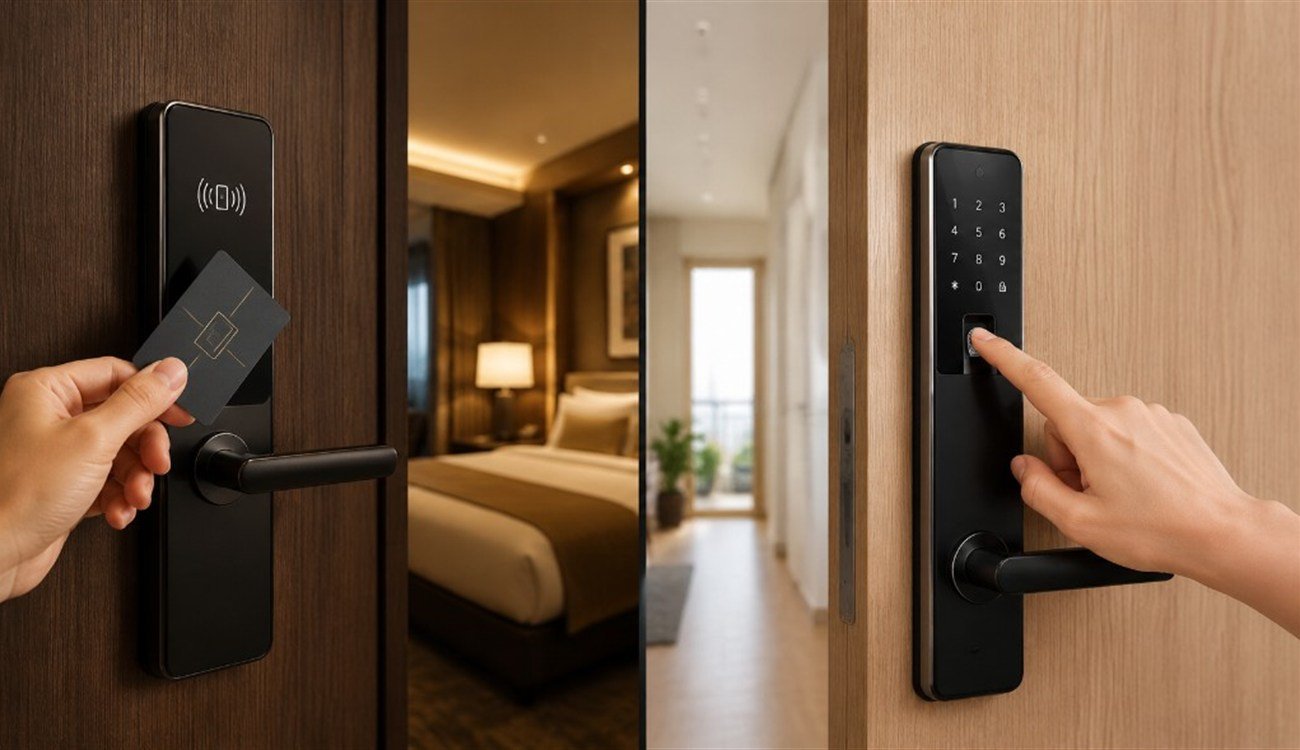
Distributors and project buyers often treat password locks and card locks as interchangeable “smart locks.” In practice, they solve different access problems. Password locks optimize remote check-in and zero-card logistics. Card locks optimize time-limited credentials, staff hierarchy, and familiar hotel turnover.
Below is a practical side-by-side for hotels, hostels, serviced apartments, and boutique projects—so you can match the unlock method to the real workflow, not the brochure feature list.
8
1. How Password Locks Work
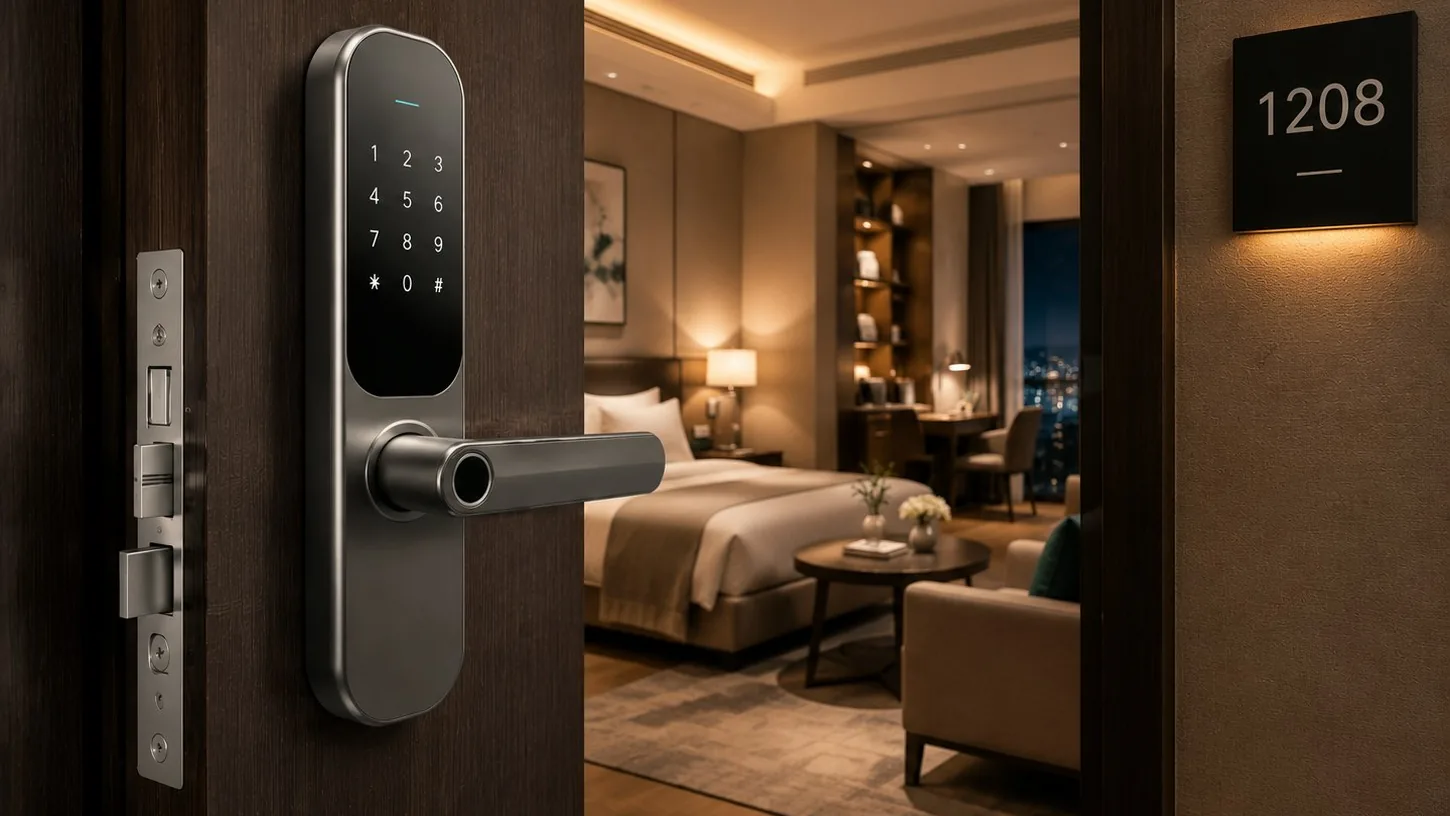
Password locks issue a time-limited or one-time code by SMS, email, app, or paper slip. Guests enter the code on a keypad—no card to encode, lose, or reissue. That makes them strong for late arrivals, contactless check-in, and small properties without a busy front desk.
A typical password workflow looks like this: booking confirmed → system or staff generates a stay-window code → guest receives the code before arrival → guest enters digits at the door → checkout deletes or expires the code. Staff can keep separate master or floor codes so one role change does not touch guest credentials.
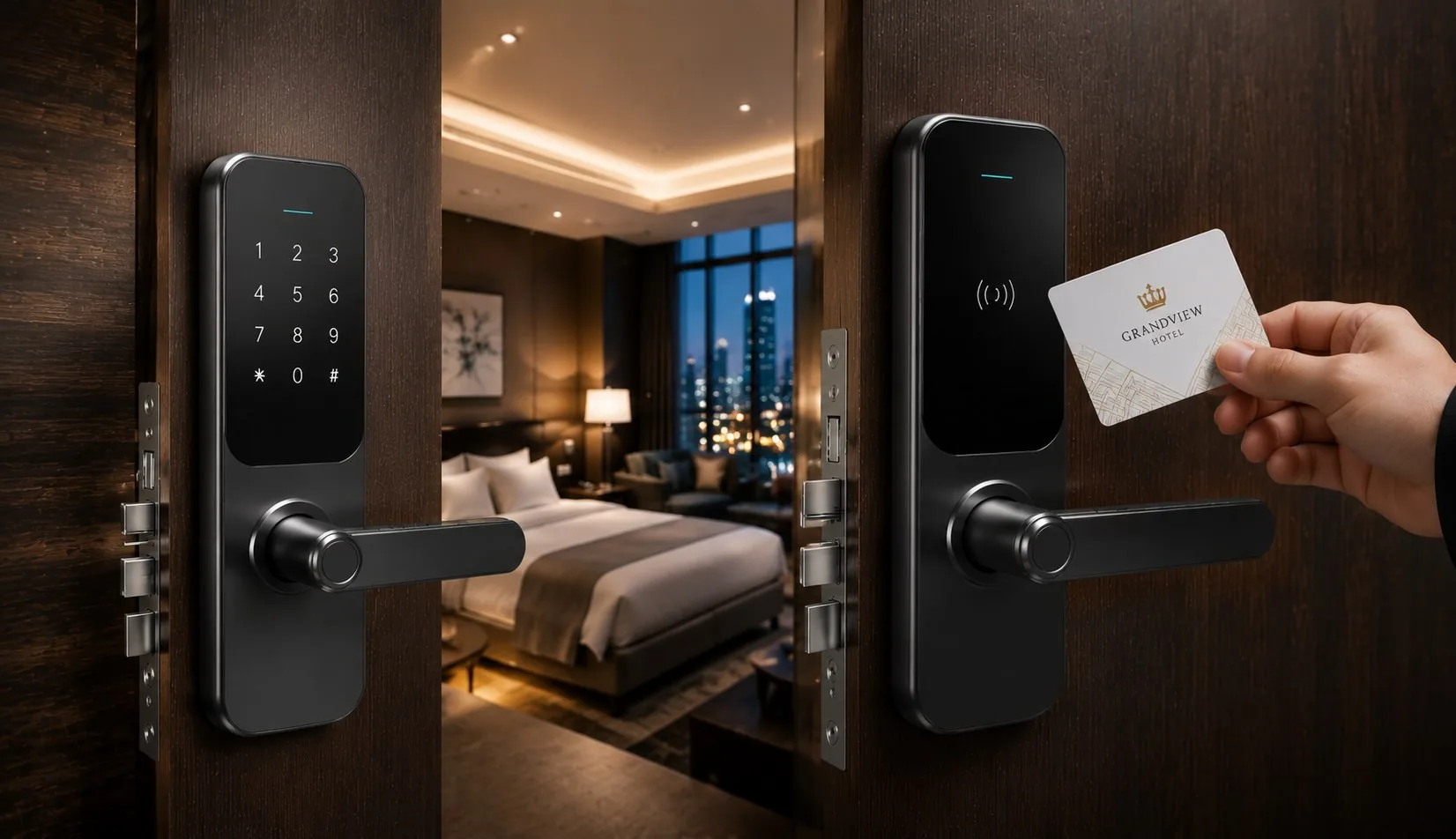
Most hotel-grade password models are multi-mode: password + card + mechanical key override (and sometimes app). The keypad becomes the primary unlock for remote stays; cards stay as backup for VIP guests, staff, or keypad issues.
- Best for: remote check-in, boutique stays, Airbnb-style units, staff doors
- Ops dependency: code generation rules, delivery channel, and delete/expiry process
- Common unlock mix: password + card/key backup
- Strength: no card stock, fast pre-arrival access, simple for small teams
2. How Card Locks Work
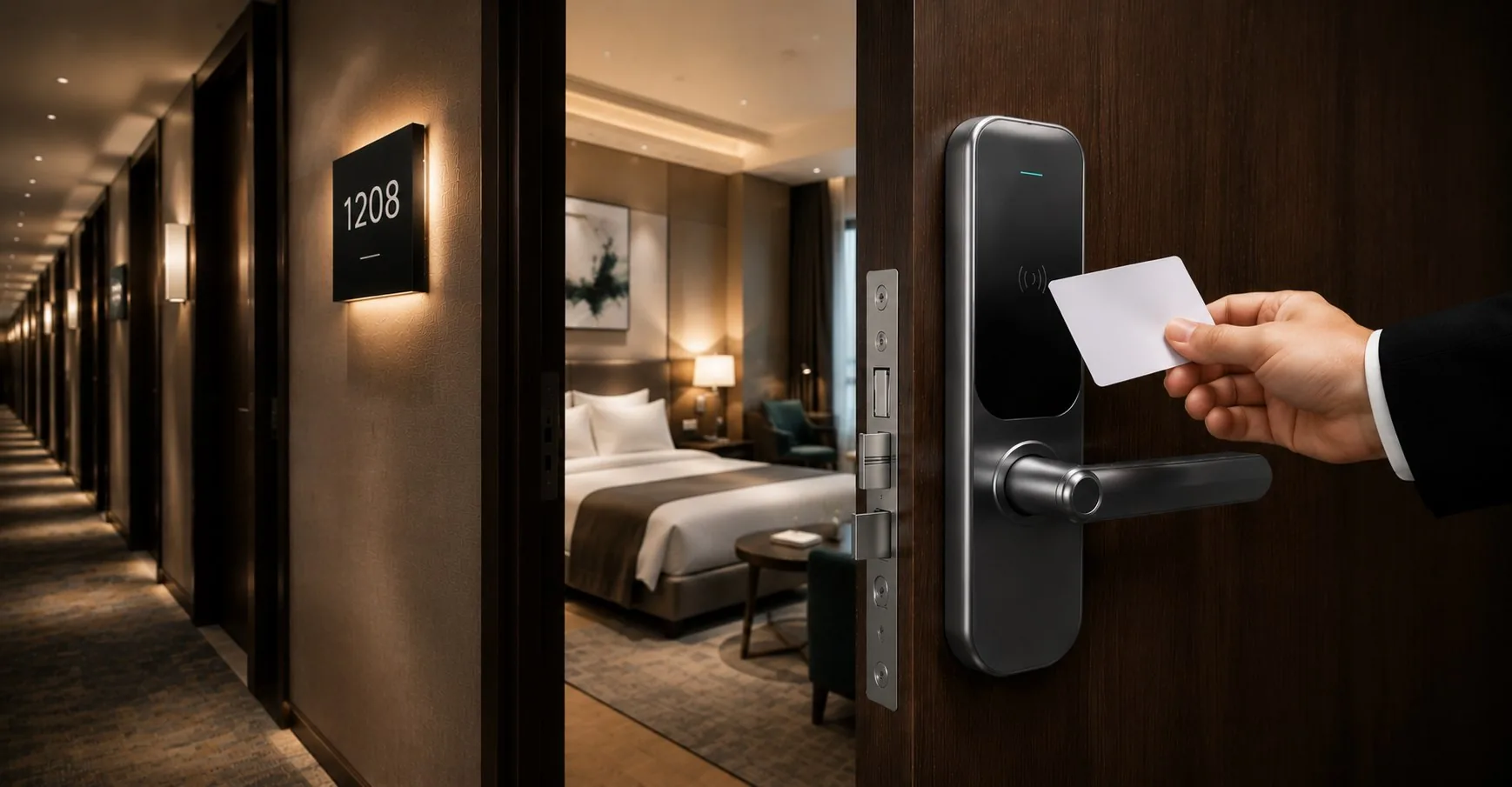
Card locks remain the hotel industry default. The front desk encodes RFID/IC cards with room number and stay window; checkout voids or expires access. Guests already know the habit—tap card, enter room—so training cost is near zero for most travelers.
A typical card workflow looks like this: guest checks in → front desk encodes a card (often linked to PMS) → guest taps the reader → checkout expires the credential. Housekeeping and engineering use separate staff cards so you can revoke one role without re-encoding every guest room overnight.
Mature hotel systems also support hybrid unlock—card + password, or card + mechanical key override—so the property is not stuck if a card is demagnetized, lost at midnight, or the encoder goes down during peak check-in.
- Best for: short-stay rooms with frequent credential changes
- Ops dependency: front-desk software, encoder uptime, and card stock
- Common unlock mix: RFID card + mechanical key override
- Strength: fast revoke, familiar guest habit, clear staff hierarchy
3. Side-by-Side Comparison
Use this table as a first filter. If your project fails on even one “must-have” row, do not force that unlock method into every guest room.
| Feature | Password Lock | Card Lock |
|---|---|---|
| Primary user | Remote / late guests, small teams | Short-stay guests + front desk |
| Check-in speed | Fast if code is pre-sent | Depends on encoding queue |
| Credential change | Create / delete / expire code | Encode, expiry, or void card |
| Access revoke | Change or delete code | Expiry, void, or re-encode |
| Guest experience | Enter digits; no physical keycard | Tap card; familiar hotel habit |
| Front-desk fit | Light desk; strong for remote arrival | Strong—built for PMS/encoder flow |
| Consumables | None (codes are digital) | Cards + encoder supplies |
| Main risk | Code sharing, shoulder surfing, forgotten codes | Lost cards, encoder downtime |
| Typical projects | Boutique, Airbnb-style, staff doors | Full-service hotels, high-turnover hostels |
| Spare-parts focus | Keypad module, batteries, mortise | Cards, encoder, batteries, mortise |
4. Cost, Ops, and Security
Unit price alone is a poor decision metric. Total cost of ownership depends on consumables, labor, guest complaints, and how often access must change.
Password locks cut card stock and encoder hardware, which helps boutique hotels and vacation rentals. Cost shifts into code delivery reliability and guest support—“I forgot my code” calls at night. Security depends on stay-window expiry, one-time codes where possible, and clear rules against long-lived shared PINs.
Card locks usually need an encoder (or cloud/PMS connection), card inventory, and front-desk training. Lost cards and re-encodes are expected operating cost, not a failure. Security strength comes from automatic expiry and staff card hierarchy—if the software workflow is solid.
For mixed buildings, the cheaper path is often a hybrid series (card + password on one lock family) with shared finishes and mortise standards—not two unrelated SKUs that double spare-part chaos.
- Password lock TCO drivers: code support labor, keypad durability, app/SMS delivery reliability
- Card lock TCO drivers: cards, encoder uptime, front-desk labor, spare locks by finish
- Shared cost items: batteries, mortise compatibility, installation quality, after-sales response time
- Security note: neither method is “always safer”—expiry rules and revoke speed matter more than unlock marketing
5. Which Fits Which Property?
Choose card locks when rooms turn over daily, front-desk control is required, and guests expect a keycard at check-in. Full-service hotels, resorts, and high-occupancy hostels usually land here.
Choose password locks when remote or late check-in is core to the offer, the front desk is light or unmanned at night, and you want to eliminate card logistics—boutique hotels, Airbnb-style units, and some serviced apartments.
Hybrid is often best. Put card (or card + password) on standard guest rooms; use password for late-arrival suites, staff doors, or apartments that need remote handoff. Keep one visual series so corridors still look like one hardware package.
- Full-service city hotel / resort: card locks (or card + password hybrid)
- Serviced apartments: password + card for short stays and remote handoff
- Boutique / Airbnb-style: password primary; card backup for staff and VIP guests
- Budget hostels: card for high-turnover rooms; password for common areas if needed
- Staff / back-of-house doors: password or card with clear role hierarchy and audit logs
6. Common Buying Mistakes
These are the issues we see most often when projects select locks by feature marketing instead of site process.
- Forcing password-only on a busy full-service hotel. Peak check-in needs encoder speed and guest-familiar cards; keypad-only raises support tickets.
- Buying card locks without confirming PMS / encoder fit. If the front desk cannot issue and void credentials smoothly, hardware quality will not save the project.
- Using long-lived shared passwords. Static codes shared across guests defeat expiry and create real security gaps.
- Ignoring door thickness, handing, and mortise type. Sampling before measuring doors creates remakes and delayed openings.
- No backup unlock plan. Every project needs mechanical key override or emergency open procedures for dead batteries and network issues.
- Skipping series standardization. Mixing too many families increases spare-part chaos for engineering teams.
7. Buying Checklist
- Map each door type to a user journey: guest room, late-arrival suite, staff door, common area.
- Confirm door thickness, handing, and mortise type before sampling.
- Ask for unlock modes, battery life, and low-power alerts in writing.
- For password locks: test code creation, stay-window expiry, delete steps, and guest delivery channel.
- For card locks: test encoding, expiry, void, and staff card hierarchy with your real front-desk process.
- Plan mechanical key override and emergency open procedures.
- Match finish to corridor hardware packages and limit SKUs where possible.
- Confirm certifications and after-sales response for your target market.
8. FAQ
Are password locks safer than card locks?
Not automatically. Safety depends on expiry rules and revoke speed. Time-limited cards and temporary codes both work; long-lived shared PINs are the real risk.
What should full-service hotels choose?
Most full-service hotels still prefer card locks, or a card + password hybrid, because front-desk encoding and guest habits already fit that workflow.
When do password locks win?
When remote or late check-in matters more than card logistics—boutique hotels, Airbnb-style units, and light front-desk properties.
9. Bottom Line
Card locks still win for classic hotel operations: front-desk control, time-limited credentials, and guest familiarity. Password locks win when remote check-in and zero-card logistics matter more. Neither is universally “better”—they are optimized for different access problems.
Start from check-in flow and revoke speed, then choose unlock modes around that workflow. For many commercial projects, the safest answer is a multi-mode series that supports both—so you can standardize spare parts while matching each door to how guests actually arrive.
Browse hotel password locks and hotel electronic locks, or contact us with room counts and door drawings—we can help you split SKUs by door type before you sample.